

The door handle FSB 1138 by Dieter Rams
Klaus Klemp
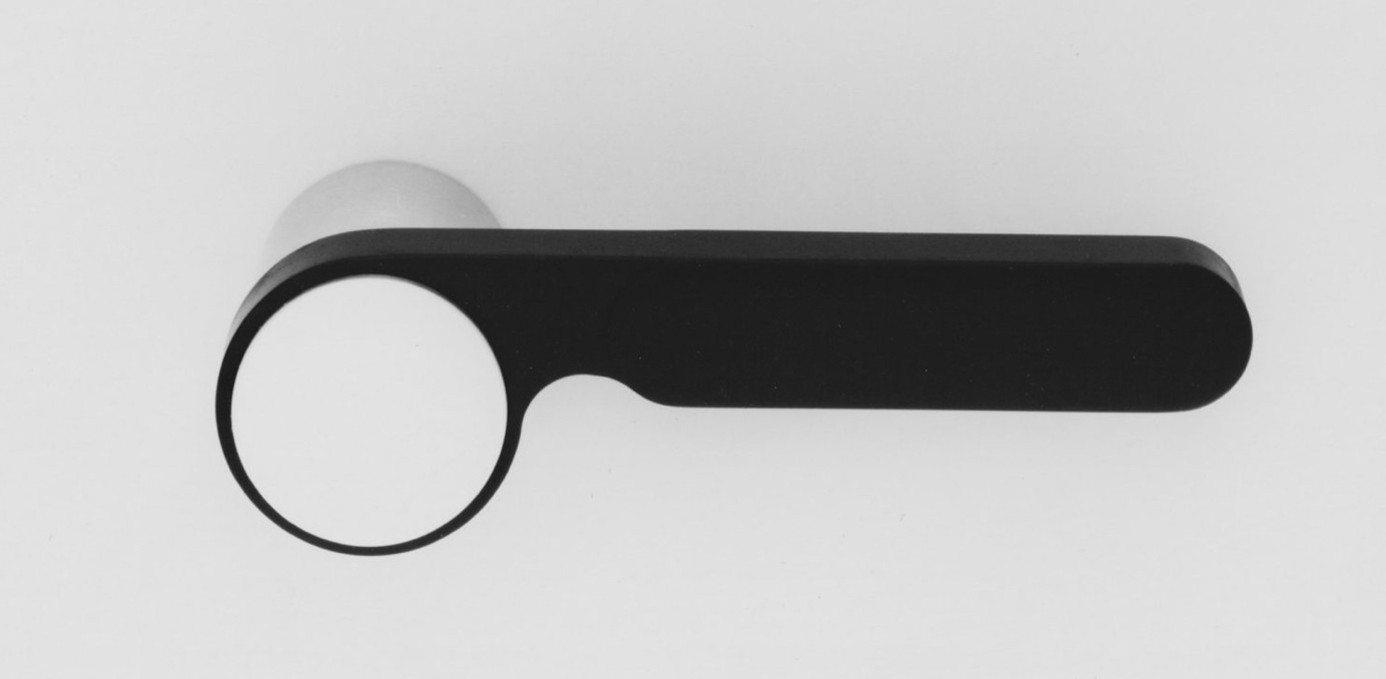
The door handle FSB 1138 (rsg 1) by Dieter Rams, produced from 1988 onwards. © FSB
While there are many manufacturers of such door handles or knobs, one in particular has stood out because the designs here were not merely viewed in pragmatic and functional terms, but also, in the broadest sense, from a cultural perspective. This called for the coming together of a number of unconventional figures.
In July 1981, a lawyer with management experience in large-scale industry became managing director of FSB, a medium-sized door-handle manufacturer located in the provincial town of Brakel in East Westphalia. What forty-three-year-old Jürgen W. Braun (no relation to the electrical goods manufacturer Braun) encountered was a solid, medium-sized company with a decent, though not exactly exciting, product range. In 1985, however, while pursuing his restrained approach to modernisation, he came into contact with a radical figure, the renowned graphic designer Otl Aicher, who was the co-founder of the Ulm School of Design (HfG Ulm) and the man behind Lufthansa’s visual modernisation and the successful designer of the corporate identity for the 1972 Munich Olympic Games. This was someone who was highly praised for the fresh and international appeal of his designs.
Aicher did not immediately give Franz Schneider Brakel GmbH, FSB, a new graphic design (‘I’m not a corporate painter, after all’), but instead urged the CEO to reflect on what he was actually trying to achieve and what grasping and handles really meant. He initially advised them to publish a book, which they did, earning the company the reputation of being a ‘book publisher with an affiliated door-handle manufacturing division’. Outstanding graphic design followed later though too.
On 20 September 1986, Jürgen W. Braun organised something that no other company in the industry had ever thought of, and which led the down-to-earth shareholders to fear that their managing director might have become somewhat megalomaniac. Internationally renowned architects of the 1980s, such as Mario Botta from Switzerland, Alessandro Mendini from Italy, Peter Eisenman from New York, Shōji Hayashi and Arata Isozaki from Tokyo, Hans Hollein from Vienna, Petr Tučný from Prague, and Hans-Ulrich Bitsch and Dieter Rams from Germany, were invited to East Westphalia for a ‘door-handle workshop’. It was not exactly a hotspot in the design world, but its seclusion lent itself to intensive work.
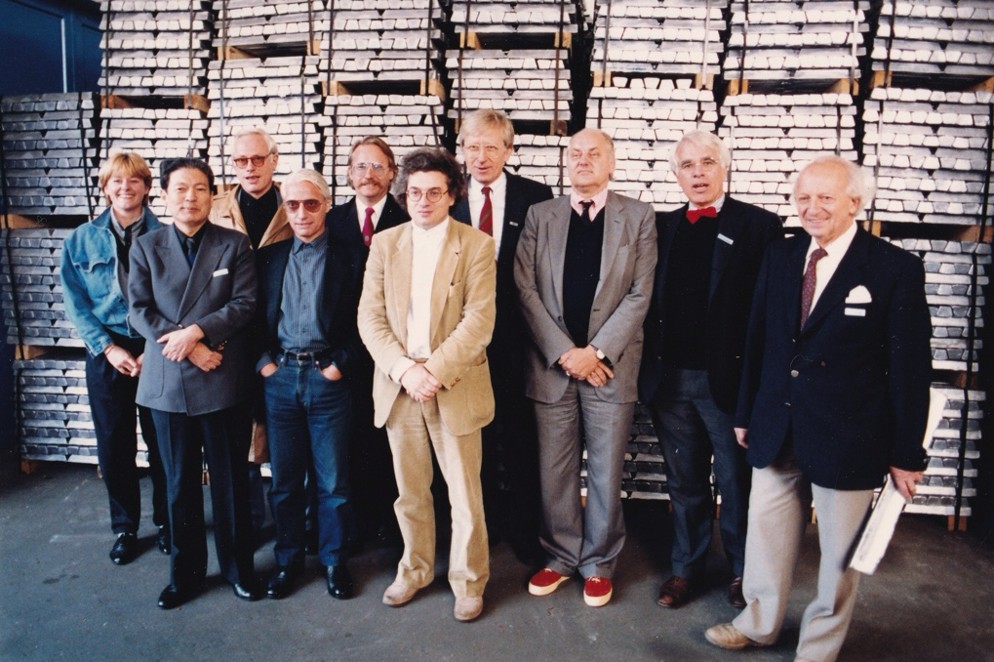
The participants of the ‘door-handle workshop’. © FSB and Timm Rautert
The large silver-coloured circular element serves as the key design feature and suggests the act of turning, which is, so to speak, the basic function of a door handle. The aluminium neck is lined with thermoplastic on both the front and back, creating a comfortable form for the hand. The recess at the bottom of the handle perfectly accommodates the index finger, allowing for a firm grip.
Otl Aicher’s search for the universally right grip led to the ‘Four Commandments of Grasping’ as early as 1985: thumb brake, index finger recess, palm support, and grip volume. Rams’ design, which was also marketed under the name rsg 1 (rams black grey), embodied these concepts perfectly. Brown had, however, already introduced the index-finger recess in 1968 with the M 140 hand mixer. In this respect, Rams was likely a step ahead of the leading designer, Aicher.

The original rsg 1 from 1988. © FSB

The new rsg 1 in Aluminium Pure. © FSB
Over the course of the Brakel workshop, Dieter Rams went on to produce two further designs, which he developed together with Angela Knoop, a student from Hamburg who had travelled with him as his assistant: the door handles rgs 2 and rgs 3.
After the competition, Rams expanded his range of door handles to a total of twenty-seven variations, which, in addition to the first three models, included window handles, rosettes, backplates, a series of special models, a cupboard handle, and a door stop. From the time when he began designing for Vitsœ, Rams had become increasingly focused on complete systems rather than just individual solutions in the furniture sector.
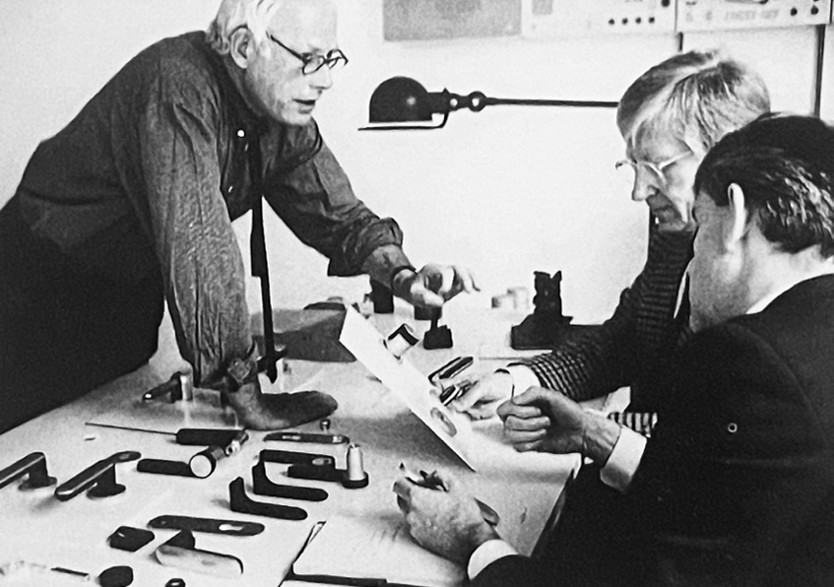
Dieter Rams and Jürgen W. Braun discussing the overall programme in Kronberg © FSB / Timm Rautert
The product line was then discontinued in 2001, either for technical reasons or because the management at the time lacked the right eye for design. Nevertheless, the new co-managing director, Jürgen Hess, found the courage to relaunch Dieter Rams’ door handle in 2023. It was a bold move, as it required a complete redesign and, to begin with, a not inconsiderable investment.
‘There is a time for plastic, for aluminium, for stainless steel. One should not downplay the symbolism of materials,’ said Jürgen W. Braun in an interview in 2001 on the occasion of his retirement. In the late twenty-first century, the time for plastic — and indeed for shiny aluminium — likely has run its course for environmental reasons. FSB therefore proposed an all-metal construction with the new ‘Aluminium Pure’ finish for the new edition of rsg 1. Rams, who had been advocating environmentally friendly design since the 1970s, gave his approval, though his insistence on retaining the correct curvature certainly proved challenging for the engineers at FSB. This is because metal simply offers different machining possibilities to plastic. Finally, after three months of intensive work, success prevailed. The entire door handle is now manufactured on site in Brakel from light and dark aluminium, or entirely black aluminium.
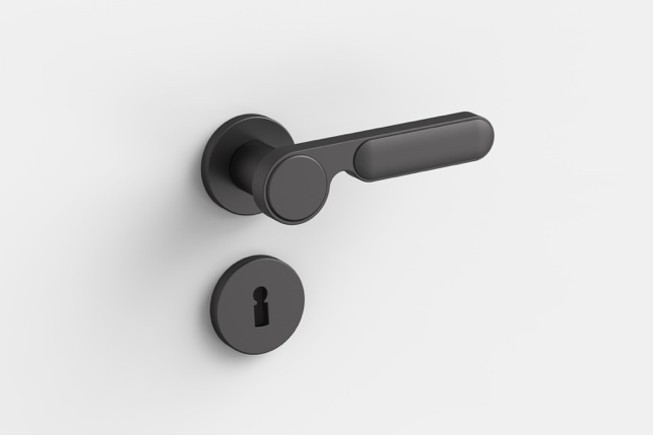
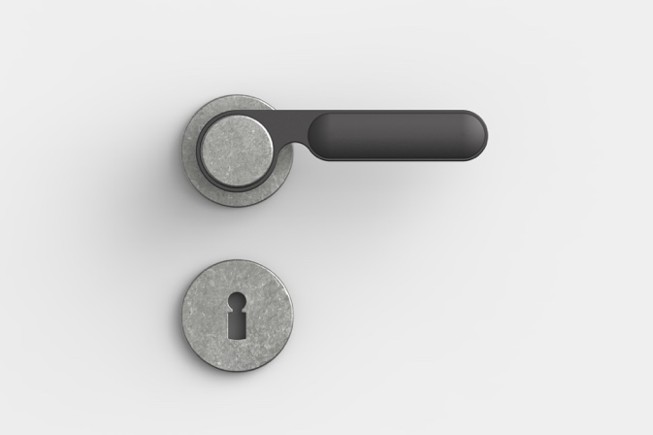
The new door handle FSB 1138. © FSB / Rendering: Haw-lin Services
Dieter Rams’ conviction that good design should be durable is confirmed in this reissue of his forty-year-old design, both in terms of aesthetics and economic viability. It really is not always necessary to reinvent the wheel.
More contributions
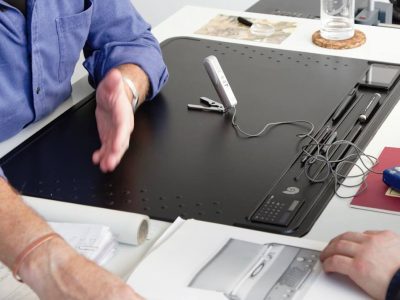
A jet-black surface with nubs
The desk pad on the Vitsœ double-top table RZ 57 in Dieter Rams’ studio is surely one of the most inconspicuous objects the designer has, and it has been part of his life for many years now. It blends so effortlessly into the workspace that it appears to be an integral part of it: necessary, functional, and largely unobtrusive.
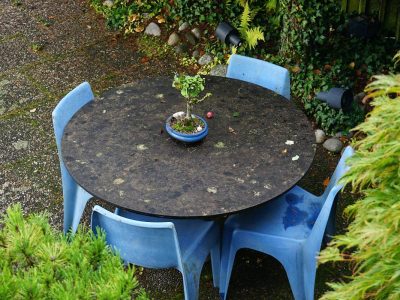
The Bofinger Chairs in the Rams‘ Garden
Four blue Bofinger Chairs have been a feature of the Rams’ garden since 1971. They perform an important supporting role there, appearing in numerous photographs in books and press articles, and of course in Gary Hustwit’s film, released in 2018, in which Dieter Rams is seen in one scene sitting at the garden table, talking with his wife Ingeborg or pruning a small bonsai tree.

The Brütting Road Runner
The Road Runner, a simple, stylish running shoe that would also make history. It has been in production by Brütting since 1970. It’s the company’s best-known and best-selling model and is still made in Germany using traditional methods, that is to say, by hand. This is a rare situation in the sporting goods market, where most products are manufactured in low-wage Asian countries.
