

‘3D printing is a blight on design education’
Interview with Fritz Frenkler by Gerrit Terstiege
The renowned product designer and university professor Fritz Frenkler has been running the f/p design agency for over 25 years, with offices in Berlin, Munich, and Kyoto. He is an appointed member of the Board of Trustees of the rams foundation, a member of the Berlin Academy of Arts and has served on the jury of the iF Design Award for over 30 years. Here, he expresses his views clearly on what needs to change in education to safeguard design quality in the future.
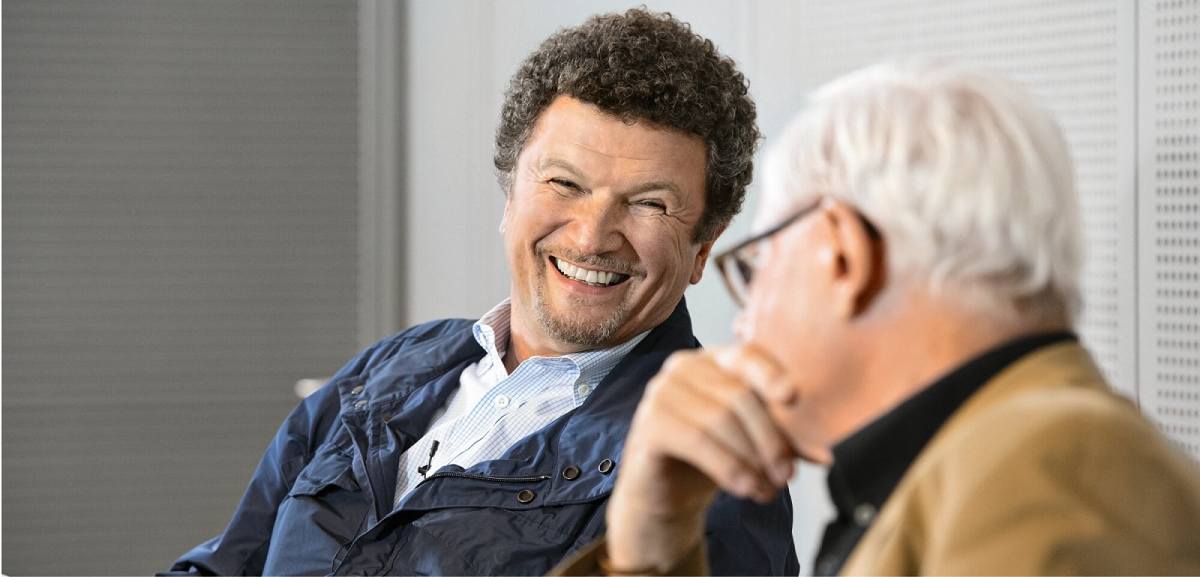
Fritz Frenkler and Dieter Rams 2016 at the Oskar von Miller Forum, Technical University Munich
© TUM/Steven Stannard
GT: Mr Frenkler, you have admired Dieter Rams and his work for decades now. Have there been any projects in your long career in which you were able to put his ten principles into practice in a very concrete way?
FF: I have always tried to apply them — not all ten principles at once, of course. The environmental aspect, for example, which Rams had already considered early on, only came to our attention later. The issue remains a challenge. We have still not fulfilled this aim, at least not entirely. I also shared his principles with my students at the Technical University of Munich and invited Dieter Rams to visit us there. His visits and our discussions with him were highlights for the students, as well as for myself. Nowadays, his principles are on display on the walls of our offices. This keeps them present, and we try to convey the significance of his principles to our customers as much as possible. In fact, they have become even more relevant over time.
GT: May I ask when Dieter Rams became a personal role model for you? Was there a particular encounter with him, an exhibition, or a publication about him that was decisive?
FF: In 1980, I saw the exhibition Design: Dieter Rams &, which was initiated and organised by the International Design Center Berlin, and I still possess the two catalogues that were published to coincide with the exhibition, one black and the other light grey. Naturally, I was already familiar with Dieter Rams from my studies — but as is often the case, he had been wrongly associated with Ulm. And Ulm had gained something of a bad reputation during my student days as a rather ‘stubborn’ institution. Nick Roericht is said to have presented a slide projector model in orange there once and was almost thrown out of the HfG for it. But Dieter Rams, and the rigour of his work, always impressed me. We later got to know each other at the ICSID, which is now known as the WDO. We were both on the board there and grew to know and appreciate each other over time, on trips and at conferences.
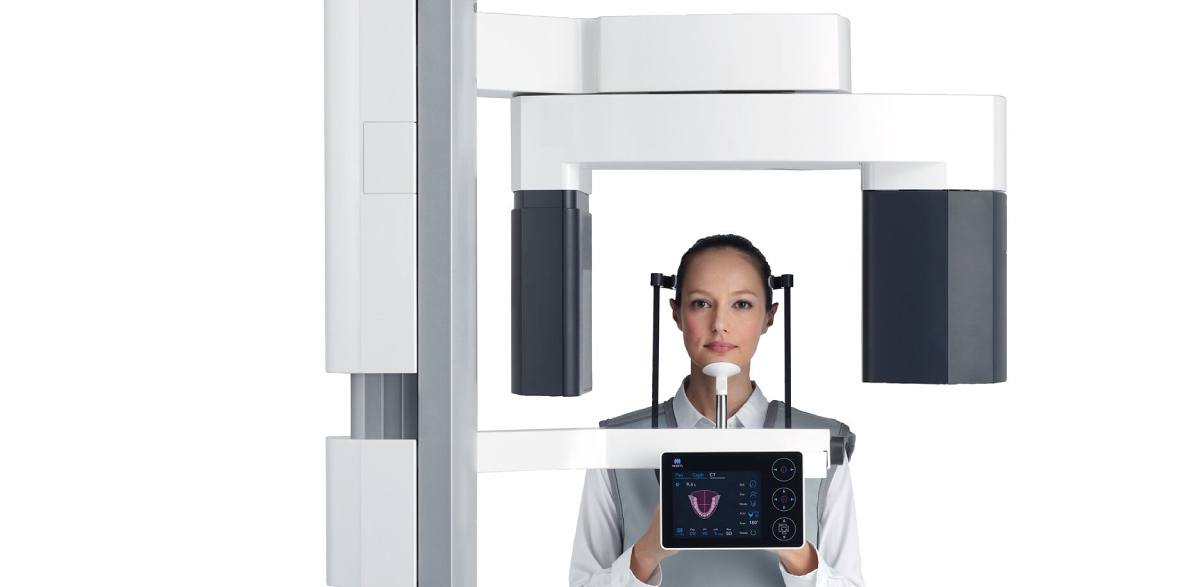
Dental x-ray Veraview X800, J. Morita MfG. Corp.
© f/p design Co. Ltd.
GT: Medical design has long been a focal point of your work, with you and your teams often choosing a very clear, simple product language, such as in the case of Morita’s dental units or Yamato’s magnetic stirrer. Do you regard such devices as universal design?
FF: Our work involves companies who distribute their products worldwide. To that extent, one could certainly speak of universal design, since we are unable to develop something different for each market. When it comes to dental units in particular, it is not a case of simply accommodating the patient—the patient must also be comfortable and well positioned. Usually, however, this results in the dentist developing back problems after twenty years of practice. It is here that universal design has a role to play. Until now, ergonomic considerations have often concentrated solely on the patient, not the dentist. Yet both should be taken into account. This demands a completely different approach to the positioning of patients. The fundamental principle guiding us as designers is that the workplace should be adapted to the individual, not the individual to the workplace.
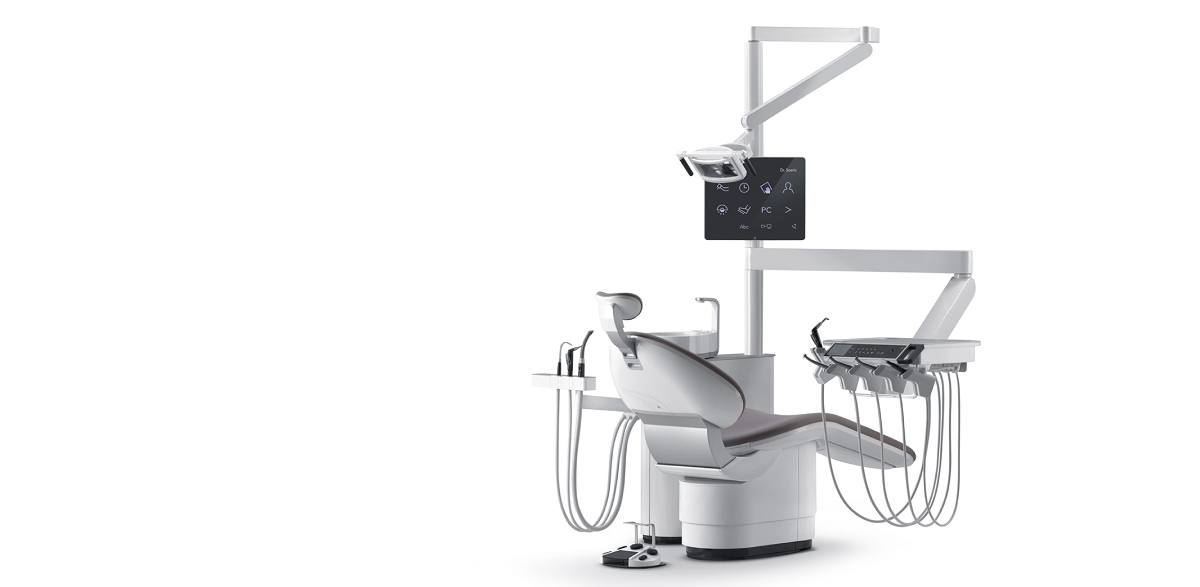
Dental treatment unit Soaric, J. Morita MfG. Corp.
© Morita
GT: In healthcare technology, it is also important to alleviate patients’ fears of technology. How can this aim be achieved? The colour scheme of devices, to name one example, plays an important role in this regard.
FF: Yes, that’s totally correct. And colours were often important at Braun, too, such as the coffee machines or hair dryers. For many devices, however, white, grey, and black were the basic housing colours. As far as healthcare technology is concerned, I am convinced that patients have more respect and trust in a doctor when the design of a practice reflects a state of hygiene. And white is the colour that most effectively symbolises hygiene, especially in Japanese culture, and also beyond. White performs a special role in many situations in Japan, like when sumo wrestlers throw white salt into the ring to ward off evil spirits. Salt is also thrown over the shoulders of mourners at the front door after a funeral. With this in mind, we decided to limit ourselves to white, silver, and medium grey. Our Japanese clients were initially concerned that any dirt would be immediately visible on white surfaces. But we explained that this was precisely the point. Afterall, one can see the dirt straightaway and then quickly and easily clean the surface. And cleanliness is the basis for trust in a medical context. Those who want to overcome fear must create trust.

Dental ultrasound scaler Solfy F, J. Morita MfG. Corp.
© f/p design Co. Ltd.
GT: In one lecture, you spoke extensively about how important craftsmanship is in Japan, particularly in relation to the intricate production of lacquerware. This immediately reminded me of Dieter Rams‘ grandfather, who had a great influence on him with his love of meticulous craftsmanship, especially when it came to polishing lacquer. What craft skills are still important for designers today?
FF: Well, I believe, and I am one hundred per cent convinced, that craftsmanship and technical experience are the foundations of good design. I became aware of this while working on my thesis, which was about computer-aided design. At that time, the design department was equipped with a single mainframe computer for CAD use. This was at Opel, which was part of General Motors at the time. I was able to examine at first hand, so to speak, and describe in my thesis how it was used and how the computer influenced the drafting work. It involved surface modelling and things like that, and I noticed that the work with the computer led to the loss of the feeling for proportions.
GT: And how can you ensure that the relationship to scale is not lost?
FF: During my time at frogdesign, we consciously drew on a scale of 1:1, on large drawing boards, with a pencil, erasing lines, defining others, then making blueprints, and this is how we approached the design, step by step. To the extent that, for example, half of a bathtub was built, again on a scale of 1:1, and the other half was simulated with a large mirror. That’s the only way to gain a clear idea of the proportions and outlines. I have the impression, and this would need to be explored in more detail, that the quality of design has declined ever since we began designing with computers. The current generation of designers should focus more on really grasping things as part of their studies, like becoming familiar with different materials and their properties, and understanding different types of wood, metal, and plastic. The same goes for graphic designers, who should get back to working with paper, folding it, scratching and experiencing tactile qualities. Erik Spiekermann sets an example with his printing workshop in Berlin. By doing so, you understand the steps involved in printing and what design possibilities arise during production. Naturally, in-depth knowledge is also important in product design, such as how to mould something, how to build tools, and what an undercut is. Today, this knowledge has largely been lost. 3D printing is a blight on design education.
GT: Is traditional model making still taught at universities today, apart from 3D printing?
FF: Hardly ever. Or at least, less and less. Instead, design schools are buying large 3D printing machines. And then they happily print away and, pressed for time, rush through many things that haven’t really been thought through in detail. And this haste leads to design errors creeping in, especially in the automotive sector, for example. This is because designers don’t get a feel for proportions on the keyboard or screen. Typing alone is not conducive to quality design. You have to pick up a pen again or work on the model itself. So, we need to return to teaching and promoting craftsmanship in order to achieve better results in design. I believe that, to an engineer specialising in plastics technology, many young designers submit designs that promptly reveal a complete lack of basic knowledge of plastics. This happens very often nowadays.
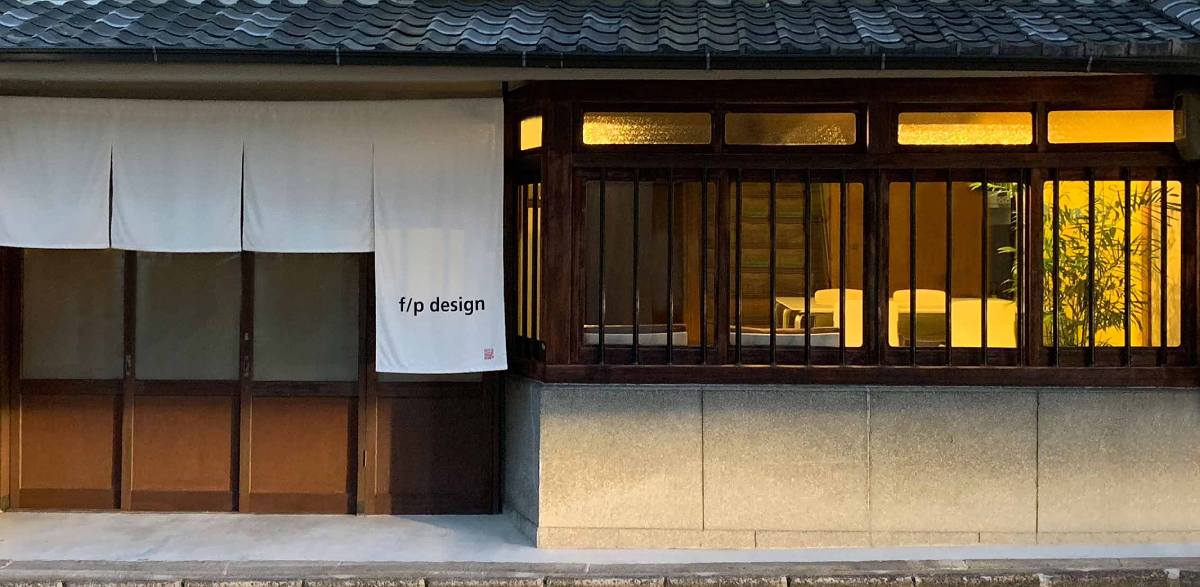
Exterior view of the Kyoto studio of f/p design Co. Ltd.
© f/p design Co. Ltd.
GT: You have taught for a long time and have remained in close contact with younger generations of designers through your offices in Europe and Japan and your jury activities. How do young designers in Japan today differ from those in Germany?
FF: Well, in Japan, people are still, shall we say, more committed to their studies, as far as I can tell.
GT: In terms of the professors or the students? Who is more dedicated?
FF: Both groups are equally committed. In Japan, students sometimes sleep for a few hours at the university in the evening and then resume their work there. Some have even constructed their own folding beds, which spares them the frequently long journey from their student accommodation to the university. Professors are also commonly available there around the clock. I think that’s one of the big differences. What I’ve also noticed is that the Japanese often look to products like those by Dieter Rams as models to study and learn from. This approach is hardly ever found at German design universities anymore. In this respect, it must unfortunately be said that the history of design is virtually no longer a subject of interest in Germany. Period. I find that a great pity. If you say, for example, ‘That looks like design X or Y by Achille Castiglioni,’ you’re met with blank stares. So often, there’s no historical knowledge left. We try to rectify this in our offices by drawing attention to past designers by presenting a one-hour talk on a designer or a design-related topic every Thursday. These talks also cover the corresponding era, attitude and design philosophy. Today it might be Castiglioni, and next week it could be Vico Magistretti or Igarashi Takenobu. I consider this important for my employees because it helps them understand what lessons they can learn from history, what they can derive from it, or even reference. Not in the sense of plagiarism or copying, of course, but rather in a clever and skilful way. Knowledge of design history is especially necessary to prevent unintentional imitation. So, to be very clear: history must once again become a major part of what is taught. If we want to do something new, then we need to be familiar with the old.
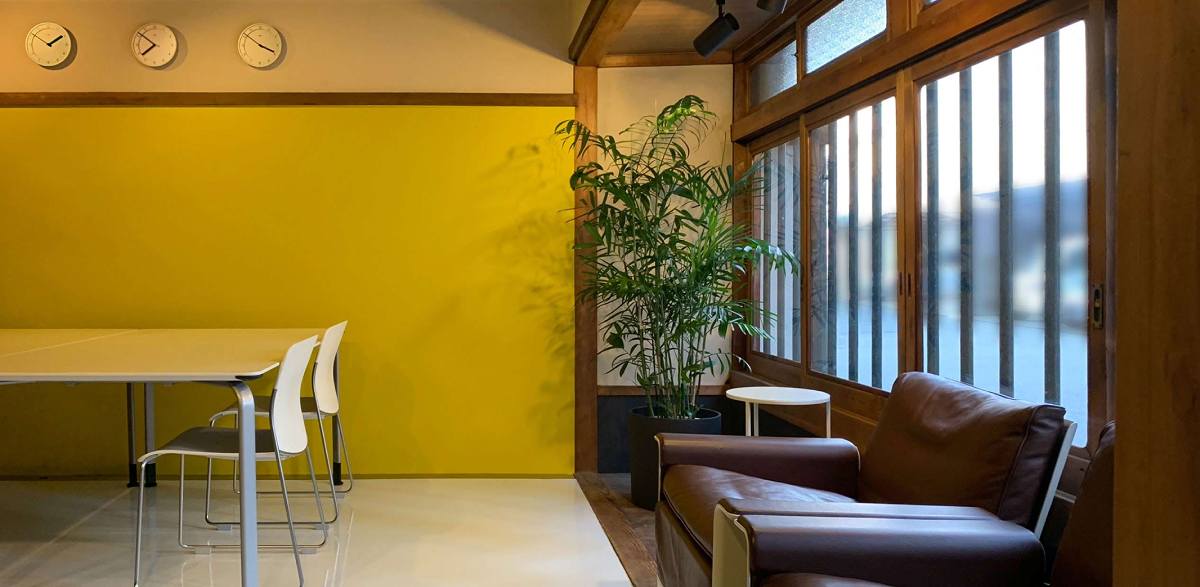
Interior view of the Kyoto studio of f/p design Co. Ltd.
© f/p design Co. Ltd.
GT: And not just these symbols, which are circulating by the thousands on social media—the so-called ‘iconic’ designs, of which often only the decal is known, but no details whatsoever.
FF: The response is often to applaud and move on. Still, I am pleased to see that Hartmut Esslinger has recently been commenting on social media. He is very active there, perhaps because he now has more time, having just turned eighty. He provides insightful commentary on contemporary design. And it’s perfectly fine to be critical at times, especially in our field, whether it’s product design, architecture or communication. If everyone always just applauds, there can be no real discourse. And that is and remains important. The same goes for engaging with other cultures. We need more general education again, which should and can have an impact on design processes and outcomes.
GT: Would you say that ideas of design cultures that are shaped nationally are still accurate and relevant today?
FF: Globalisation has certainly homogenised many things today. Take automotive design, for instance. Twenty years ago, a French car was easier to identify than today. And an Italian car was clearly different. That said, there were also people like Giorgetto Giugiaro, who had a tremendous influence on German automotive design. By the way, I have never understood the Japanese automotive industry. I don’t know where they get their influences from. Toyota, with its very hard-to-understand design and details, has in my opinion nothing to do with Japan at all. I think something went wrong there somehow. Marketing has a powerful influence on design in Japan. For many years, it wasn’t brand design that was practised there, but marketing design, and then different designs for different markets. Today, much of this is no longer apparent in terms of formal aesthetics. In contrast, I see a positive development at Honda. There is hope when you look at the small electric car “Honda e” with its round headlights and cameras: it suggests something of a return to Japanese design traditions and their very own culture.

Rear view of the “Honda e“ electric car with a clear design language
© Honda
GT: All too often, too much is expected of the overall bodywork, especially in small cars: too many ideas compete with one another in a confined area, indicators and entire headlight units are given exaggerated proportions, and some are dynamically tapered to give the design something special or spectacular. The result is a wild, excessive collage.
FF: Precisely. Something has gone wrong. And you can see it now with BMW, what they’ve done with the double kidney grille, how they’ve made it absurdly large and placed a halo of light around it… Perhaps they need to rethink their entire design language and start from scratch, instead of reducing themselves to satire.
GT: How do you see the future of industrial design? How will the conditions for the profession change, and to what extent will AI threaten or enrich the field in the years to come?
FF: AI is not only a threat to the design profession. If we don’t keep it in check, AI will endanger all creative life. We’ll have books by authors we’ll probably never meet because they don’t even exist. We’ll have designs that no one has actually designed or thought through properly. Yet in some areas, AI should definitely be supported, such as in medical diagnosis. I’d actually go so far as to argue that we should intervene at a very early stage and stop this from going ahead. Of course, we know that many things are difficult to control in a free world. But I believe that in order to develop worthwhile products, we should reintegrate the human senses — and the human ability to perceive and feel things — more firmly into the development process. Moreover, when it comes to products, the focus in future will be far more on looking after and maintaining them. That is something AI cannot do. You still need manual skills and technical knowledge, even as a designer, in order to anticipate how repairs to devices and machines can be made easier so that things last longer — especially in times of rising energy and material costs. So yet again, what Dieter Rams said also applies here: ‘Less, but better’.
More Contributions
Mark Adams
Mark Adams, the long-time CEO of Vitsœ, talks about working with Dieter Rams, the difficult search for the right designer for the headquarter in Royal Leamington Spa – and his vision for the future of the company.
Till Schneider
Till Schneider is a partner at the international architectural firm schneider+schumacher. Here, he shares his perspective as an architect, gives insights into his creative partnership with Michael Schumacher, and comments on design as a discipline.

Päivi Tahkokallio
A conversation with a special perspective from the far north: Päivi Tahkokallio is one of the most prominent strategists and design activists in Finland. What does she think about Dieter Rams‘ legacy? And what topics and issues is she currently campaigning for?
/magazin/interviews/fritz-frenkler/
