

‘‘I would see a danger if AI were to take over the higher-level thinking’’
Interview with Oliver Grabes by Gerrit Terstiege
Oliver Grabes has served as Head of Design at Braun for seventeen years and as Vice President of Innovation Design for P&G Grooming for twelve years. At present, the new possibilities offered by AI-supported design processes pose a challenge that needs to be discussed.
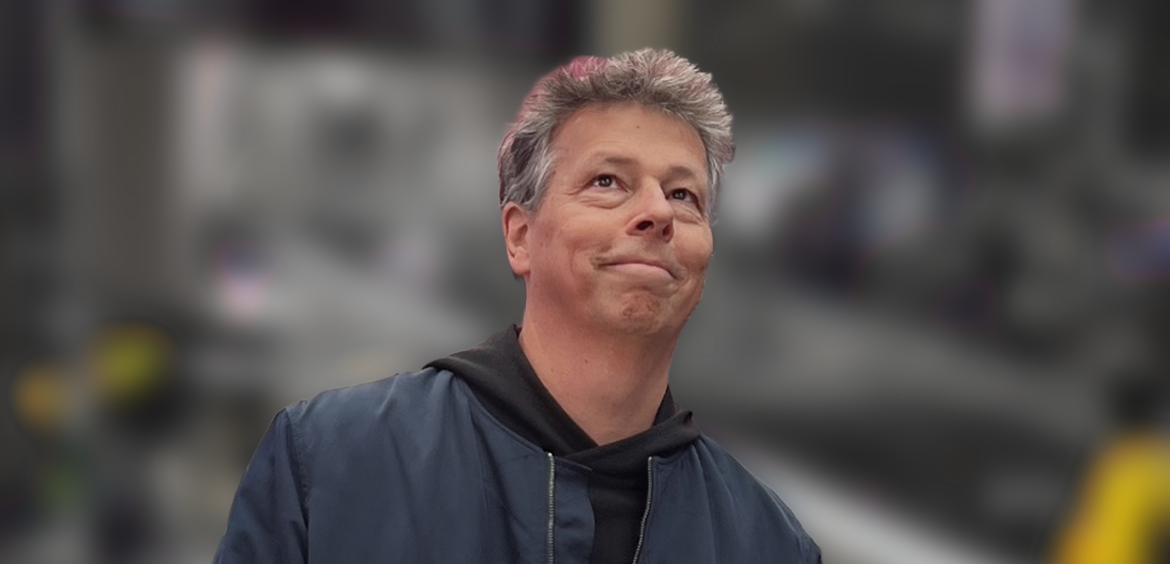
Oliver Grabes is Braun Head of Design since 2009
© Mel Huettenberger
GT: Before joining Braun, you designed products for a wide range of companies, including Nike, Sony, Panasonic, and Microsoft. Is it easier or more complex to work for just one brand?
OG: The design work for those brands was different because I was only involved on a project-by-project basis. In that role, I was able to focus much more on the design itself and was a consultant and source of ideas. Now, at P&G, the focus is on thinking through the design process from start to finish, following a product all the way to market launch — and for many years afterwards. That changes the perspective. You plan with a much longer-term view and feel a sense of holistic responsibility.
GT: How do you manage to stay motivated over such a long period of time — to keep up with the latest trends in design, technology, and culture?
OG: That’s a good question. To some, it might seem like we’re always doing the same thing over and over again. But that’s not the case. There are many changes taking place, and there are always opportunities arising, such as applying new technology to find new solutions to evolving user needs. In the past seventeen years, there hasn’t been a single occasion where we have said: this is exactly how we would make the product again. Development is always happening. And that’s what makes it exciting. It’s like football: It’s always about the same thing, but every game is new and different.
GT: Is there something you’ve learned from Dieter Rams?
OG: Yes, I learned so many things. Both directly and indirectly. First of all, Dieter Rams is a truly special person to me. The clarity and determination with which he articulates his approach to design — and to other creative contexts as well — is something one can really learn from. That’s truly special. And over the past seventeen years, we’ve had some very good conversations, often in his study at his home. Those were hours that inspired me and left an impression on me. And then, of course, there is his body of work, which is the legacy of decades of design work for Braun in a management position. As a result, hundreds of outstanding, consistently designed products were created. And, naturally, his ten principles continue to provide guidance for us Braun designers today.
GT: To what extent does AI play a role in your work today? Has it already become an integral part of the design process, or is it still a matter of exploring its potential?
OG: This is an important issue because AI is now starting to significantly transform processes. I’d say we’re currently in an advanced phase of learning about it. Until recently, AI wasn’t precise enough for us, at least, to actually be used in design projects. We were mostly just observing it. That’s changing now. Over the past few months, the results have been impressive, and at the same time a bit scary as well.
GT: Have you got a new program? Is that why?
OG: Well, a lot of new AI tools are coming onto the market. In fact, something new seems to appear almost every week. Like many other companies, P&G has a secure digital space, a kind of bubble, where we can generate things that aren’t used for external training. We always make sure that everything is done in line with corporate guidelines and remains confidential until it’s released to the public.
GT: How are you approaching the topic of AI as a design team?
OG: We set aside an hour every week to focus on AI together, to share our experiences and the new knowledge we’ve gained over the past week. By doing so, everyone plays their part in this upskilling process. We are well aware that, in our design context, productivity will suffer if we don’t use AI. Some tasks are simply completed much faster. Others wouldn’t be possible without AI. Certain visualisations would be extremely time-consuming to create in CAD, such as an electric razor in use in the shower — before it actually exists. Just to visualise drops of water on the surface of a product used to be rather complicated to realise in CAD or with a photo in a convincing way. But with AI something like that can be done rapidly. We use the new tools to better explain the product context or specific functions, but so far only to a limited extent within the detailed design process itself. And in a way, I’m glad about that; it means that the control over the design — and the thinking and creation process why we design something a certain way — remains with us designers.
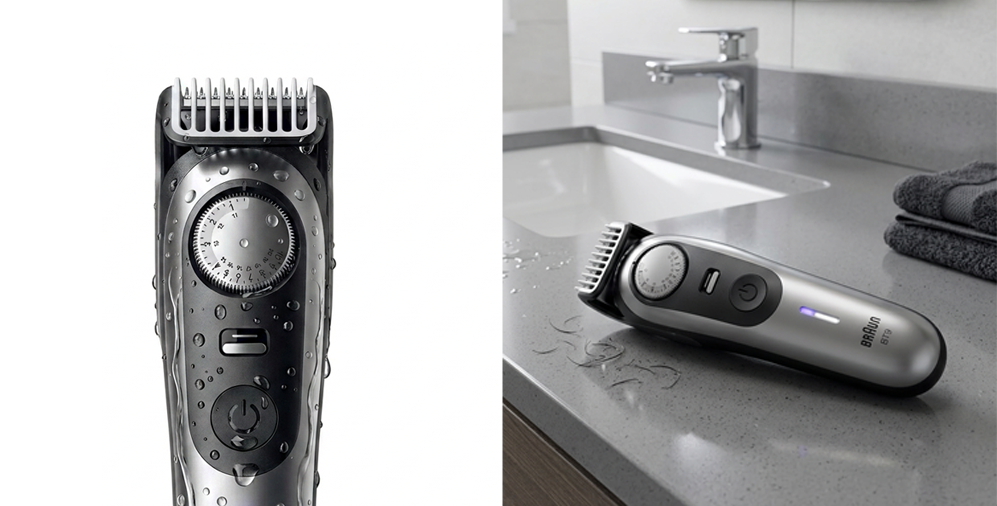
AI simplifies product communication: Braun shaver with water droplets in a bathroom setting
Graphics: Kong Linxuan & AI software
GT: How exactly are AI processes carried out? I imagine that AI could make it easy to run through different designs for Braun’s signature buttons or switches… or colour and finish options as well.
OG: These are things that traditional design programs can already do very well. Often, it comes down to speed: does it speed up the process, or does it allow me to do something I wouldn’t otherwise be able to do? Especially in the early experimental phase, it’s worth exploring different visualisation options also with AI. I’m sure that will become increasingly common in the near future. However, we’ve reached an important consensus: the design tools used shouldn’t be noticeable in the final products. After all, ultimately, we want to achieve a good, simple, clear design result that fits to the Braun brand.
GT: In contemporary architecture, the digital design process is increasingly apparent. Designs are often expected to be highly distinctive and concise. The focus is not on clear, understated design, but rather on eye-catching forms, materials, and proportions.
OG: It will be up to us to decide what we allow and how we use AI tools. If we continue to automate the design process, where will that lead us? Won’t the results generated by AI become arbitrary? Does AI-generated design align with our brand values? These are questions we, as a design team, should find answers for.
GT: Dieter Rams deliberately kept his design drawings simple — with hardly any shading or dramatic perspectives. Is sketching still part of your practice? In the traditional sense, with a sketchpad and pencil?
OG: Yes, there’s still a need for quick sketches — whether during a team meeting around a table in Kronberg or in a video conference with colleagues in Geneva and Boston. We often share a laugh when I hold a pretty bad, hastily drawn sketch up to the camera. But the main thing is that the other person understands what you mean. A sketch is still unbeatable, especially when it comes to quick communication during a collaborative design process. Or, of course, simply when you want to capture a design idea — wherever you happen to be. The tactile and haptic dimension is also very important for our products. In that respect, purely digital or two-dimensional visualization is often insufficient. I drove to the office this morning before our interview to get a feel for a texture we’d milled overnight. I wanted to touch it and get a sense of this texture before we decide to turn it into a proper design model. Fortunately, just as it was many years ago with Dieter Rams, we still regard model-making a central part of the design process within our team. We don’t finalise any designs that have only been created on a screen.
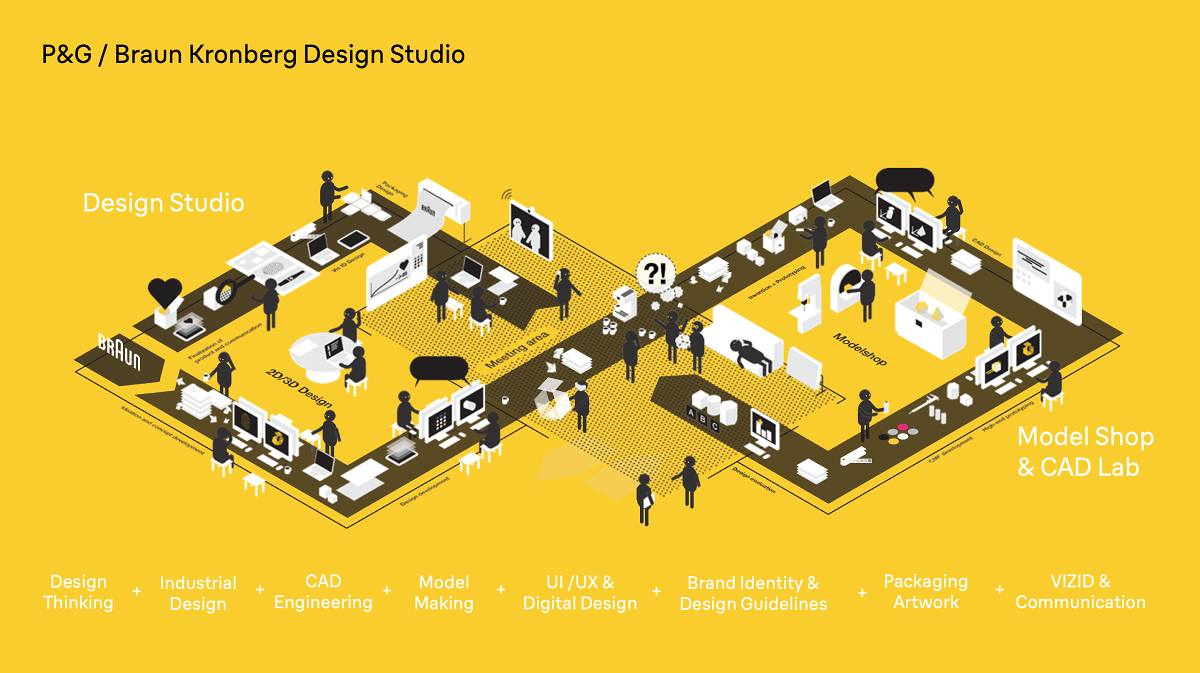
Working in the Loop: areas of operations in the Braun design studio
Illustration: Philipp Goeder
GT: Does AI actually generate design ideas?
OG: I would say, an idea can develop in different ways. AI basically offers another one how it can develop today. But this additional possibility is no guarantee that a good idea will result from it. I still consider openness and the ability to imagine and observe to be key qualities for good designers. After all, so much of what we do starts with questions like: what’s better for the user? What can provide an even better product experience? And what designs and what materials are best suited to creating a device that makes sense and lasts as long as possible? Very often, it is precisely the small details that allow us to further develop the design language — a new texture, or a tactile or visual cue. I mention this important concept as a reference to Richard Fischer, a former Braun designer under Rams who later became one of my professors at the HfG Offenbach.
GT: You’ve been an honorary professor of strategic product management in Wuppertal for quite some time now. That means you’re naturally in direct contact with younger generations of designers. To what extent do they already take working with AI for granted? Would you say that students need to be somewhat restrained in this regard?
OG: It is very much down to the teachers to convey the right processes, values, and content. After all, AI makes it incredibly easy to present poor ideas in a highly effective manner nowadays. This naturally poses a danger — when weak designs actually look spectacular. This situation did not previously exist in the same form. You had to spend many weeks thinking about what you were doing, going through the elaborate process of initial sketches, refined drawings, preliminary models, and detailed models. You engaged intensively with an object. Everything moves very quickly these days. People just let AI do its tricks and see what comes of it. Then, if it looks even vaguely cool, they think they’ve already succeeded. I therefore view it as one of the duties of those who teach design — and also as one of the duties of the rams foundation — to steer this trend in a better way. It’s important not to remove human thought from the design process. It’s about helping and asking: For whom and why am I designing something? And what is my point of view — or the values of a brand I’m designing for? What is good design? And how can we achieve that, regardless of the tools we use?
GT: I can also imagine that the content of portfolios has changed because of AI. Along with students‘ expectations regarding the pace of assignments. Since what used to take two or three weeks can now be completed in an afternoon. How could a professor help to slow down the design processes?
OG: You can for instance create a checklist that can be assigned as tasks or challenges and can guide the process. You then say: Don’t just get started. First think carefully about how to address certain points. In this way, a more in-depth approach is encouraged. When it comes to implementing the plan, you can say: Right, now try to make certain aspects tangible in a way — not just with AI, but as something human, made by hands, yet in line with the boundaries we defined earlier, so that we achieve an outcome that meets the criteria that are important to us and reflects our core values. My intention is not to slow the design process down, but rather to ensure that this mode of thinking comes first, and to define what I actually want and why. When this is clear, the design process can be fast.
GT: Your idea of a ‘checklist’ reminds me of Dieter Rams’ ten principles. After all, they also serve as a set of criteria, a system of values, with boundaries and guidelines. Surely something so complex can’t simply be fed into an AI program with the instruction: ‘Give me a clean, understandable, honest, objective, functional and ecological product in the spirit of Dieter Rams’ … or would something like that actually be possible?
OG: That’s certainly possible. And who knows, perhaps we’ll work more and more like this in the future, which would be desirable in the case of the Ten Theses. I would see a danger if AI were to take over the higher-level thinking in education, including the definition of an attitude — I would see a danger in that. As a teacher, or in my role as Design Lead at Braun, I always try to encourage people to think about what we want. And only then to begin with the implementation, the visualisation and execution. And not simply start ‘prompting’ away and leaving everything to AI.
GT: In this context, the history of design is likely to take on a new significance. It often seems as though the knowledge of how things came to be has been lost. Nonetheless, those who are aware of the design struggles that went into the SK 4 or the T 1000 are bound to view a design solution developed in five minutes with scepticism — particularly when AI has played a role.
OG: Exactly. Fortunately, we have the Braun Collection here in Kronberg, which we often make use of for almost all the visitors who come to see us. The path to understanding the Braun brand very often passes through our collection, which provides an excellent explanation of our values and our history. There’s really no need to say much more after that. The collection becomes the common ground that helps us better understand the current situation. You then look at things through that perspective. And that makes the discussion easier and explains why we do things the way we do.
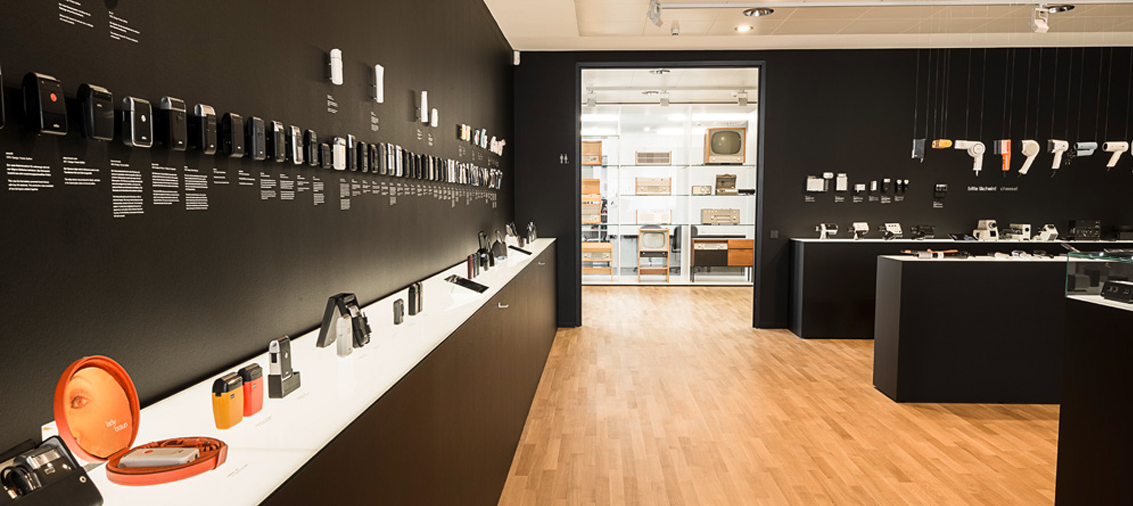
A look at the Braun Collection in Kronberg
Photo: Nils Geisselbrecht
GT: That brings me to the Braun Prize. Does it still serve as a means of identifying young talent for the team? I believe the prize was relaunched in 2025.
OG: Well, we didn’t exactly re-launch it. In fact, we’ve continued to award the Braun Prize every three years. But it was certainly a little less visible during the COVID period. In 2021, we couldn’t hold a physical event to mark it, as that would have been irresponsible. So, we ran it entirely online that year. At the Braun + Design Collectors’ Fair in 2025, we held a small celebration event with the winners of the 2024 prize. It was a real pleasure to get to know them and to see the people behind the respective projects. And to answer your question, the Braun Prize builds a network of exceptional talents who connect with one another. And even if it doesn’t lead to employment in our design team, we stay in touch. The submissions had already changed significantly even before the use of AI — the standard of presenting a product idea has become incredibly high. If you look at the videos and animations from those who were awarded in 2024 — they are now often barely distinguishable from major brand presentations.

Design language in application: Braun IPL device Skin i-expert and Braun shaver
Photos: Braun design team
GT: As far as razors are concerned, Braun clearly separates its products by gender: The men’s razors have a very high-tech, clean and robust look. The epilators for girls and women, meanwhile, usually feature flowing lines, soft shapes, and delicate colours. Why has the brand not moved more towards unisex design?
OG: At P&G, we always try to pay close attention to our users right from the very start of the product development process. How can we best assist people? What are their difficulties and concerns? What else can we improve or simplify? This approach guides us and we then apply it to our design within a clear brand context. The simple fact is that the vast majority of men actually prefer a more technical design language for razors. We know this from numerous tests. We have also tried out more neutral, less gender-specific product designs. However, these were far less in demand and less popular. That said, Braun uses a common design language for both genders, which clearly defines our design principles, such as the design of control elements. These are always shaped as circles or elongated holes. There are no exceptions. Based on this design language, Braun products are created across very different categories, yet they have a lot in common in terms of design.
GT: Broadly speaking, there is a call, including from politicians, to improve the repairability of electrical appliances. This also means changes to the design. For example, screws, which were long considered inelegant, are now being accepted again. In what ways are you making it easier to repair Braun products?
OG: Yes, it really is a very positive development that we have made such progress on this issue in the shaver category, which is so important to us. After all, Braun shavers have had visible screws for decades. This is also intended to make it clear that the device can be repaired should a problem ever arise. We have built up our own support service where products are repaired and parts are replaced very quickly. This brings us back to Dieter Rams and his ten principles: the popularity of his approach and the growing importance of sustainability in design are directly linked to the consistent development of honest, durable design. Designing the rest of the device is then the next step. We’ve simplified many elements to reduce the complexity of repairs. This approach to design may not be visible to the user, but it’s hugely important.
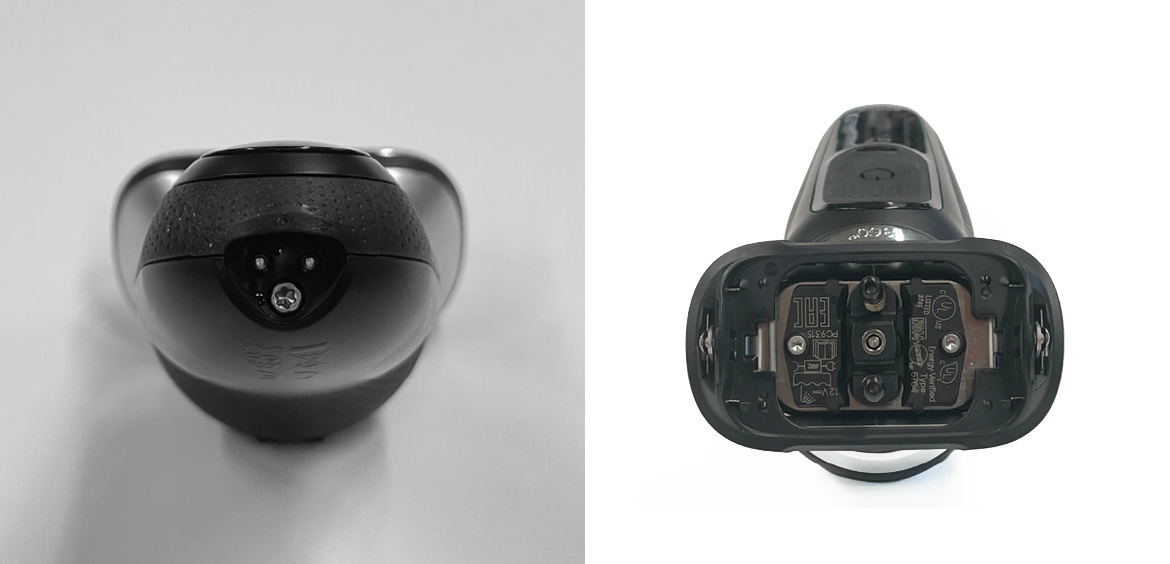
Demonstrating repairability through visible screws
Photos: Braun design team
More Contributions
Fritz Frenkler
The renowned product designer and university professor Fritz Frenkler has been running the f/p design agency for over 25 years, with offices in Berlin, Munich, and Kyoto. He is an appointed member of the Board of Trustees of the rams foundation, a member of the Berlin Academy of Arts and has served on the jury of the iF Design Award for over 30 years.
Mark Adams
Mark Adams, the long-time CEO of Vitsœ, talks about working with Dieter Rams, the difficult search for the right designer for the headquarter in Royal Leamington Spa – and his vision for the future of the company.
Till Schneider
Till Schneider is a partner at the international architectural firm schneider+schumacher. Here, he shares his perspective as an architect, gives insights into his creative partnership with Michael Schumacher, and comments on design as a discipline.
/magazin/interviews/oliver-grabes/
